
Musk, and the model.
He co-founded the lab that became the industry leader, left it, spent years criticising it, and then built a competitor. The timeline explains more than the commentary does.

The short version
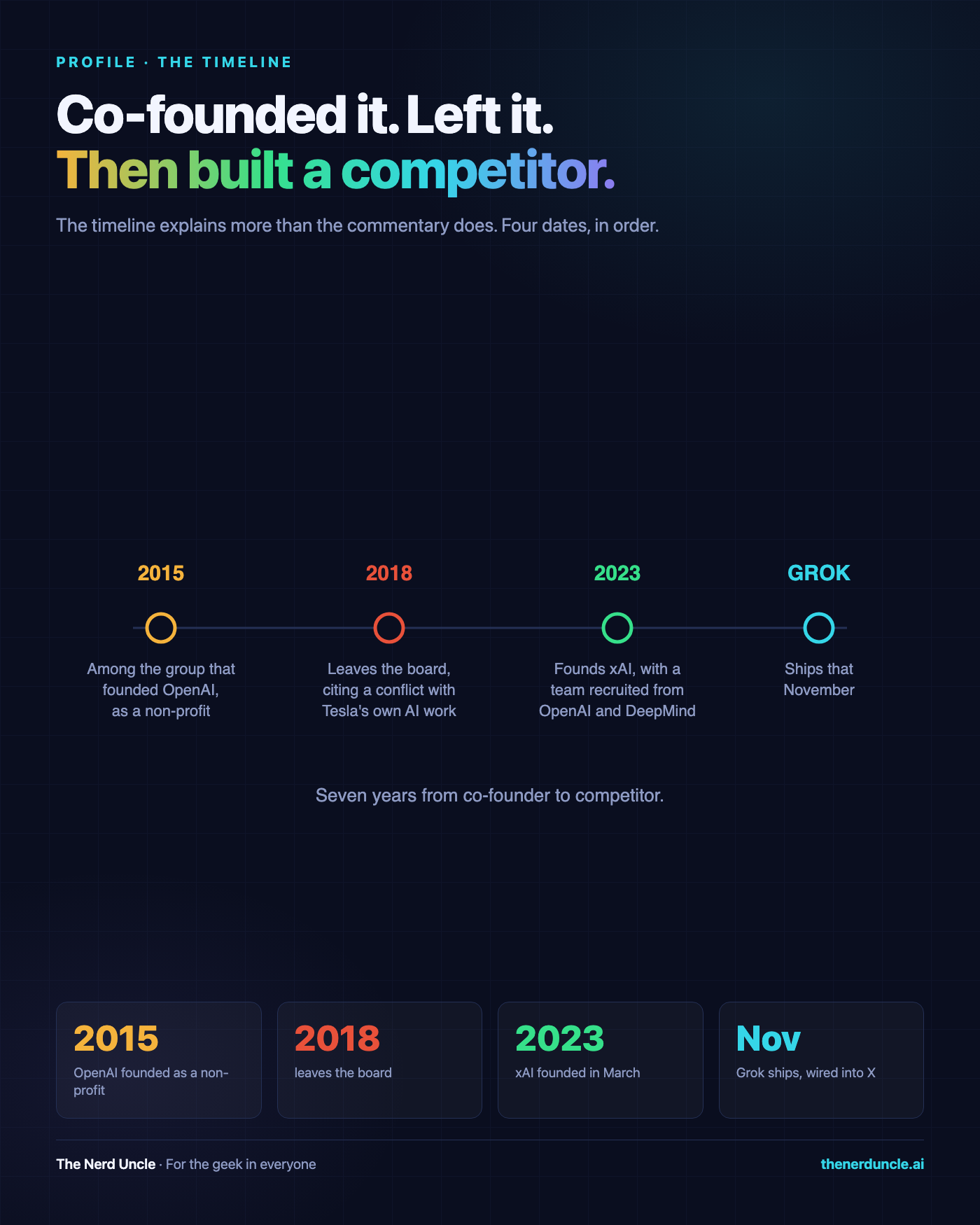
Musk was among the group that founded OpenAI in 2015 as a non-profit, and left its board in 2018 — he cited a conflict of interest with Tesla’s own AI work. He later criticised the organisation publicly for moving away from that non-profit footing, and in March 2023 founded xAI, announced that July with a team recruited out of OpenAI, DeepMind, Google Brain and Tesla.
Its assistant, Grok, shipped in November 2023. It was reportedly going to be called TruthGPT. In 2026 the company was reported to have rebranded under the SpaceX umbrella.
What makes Grok different
Mostly one thing: it is wired into X, so it leans on what people are posting right now rather than only on what it absorbed in training. For questions about what is happening today that is a genuine advantage.
It is also the obvious risk. A model drinking from a live social feed inherits whatever that feed is saying, including when the feed is wrong, coordinated, or simply loud. The product has drawn repeated criticism over its outputs, and the honest framing is that this is a design trade rather than a bug to be patched.
The part that actually matters
Strip out the personalities and the useful observation is this: the same person helped start the leading lab, decided it had gone wrong, and had the resources to build an alternative within a few years. The barrier to founding a frontier lab is capital and talent, not permission.
That is why there are now several credible models rather than one, why they are close enough in capability that switching is realistic, and why nobody buying this technology should be designing around a single vendor.
What to do with that
Keep the model swappable. If changing provider means rewriting your product, you have bought the wrong architecture.
Judge on behaviour, not announcements. What it refuses, what it records, where it can run — those outlive a version number.
Be careful what you wire to a live feed. Freshness and reliability pull in opposite directions, and for an operational decision reliability wins.