
Meta built an assistant that keeps working after you leave.
Muse is Meta's personal agent, and the pitch is not a better chatbot. It is a thing you hand a job to and walk away from. That distinction is the whole product, and the whole problem.

There are two things called Muse and it is worth separating them before anything else, because the press coverage mostly does not. One is a family of models Meta's Superintelligence Labs began shipping in April 2026 — Spark, then Glimmer, then Wonder. The other, announced in September, is a consumer product: an agent you talk to, built on top of them.
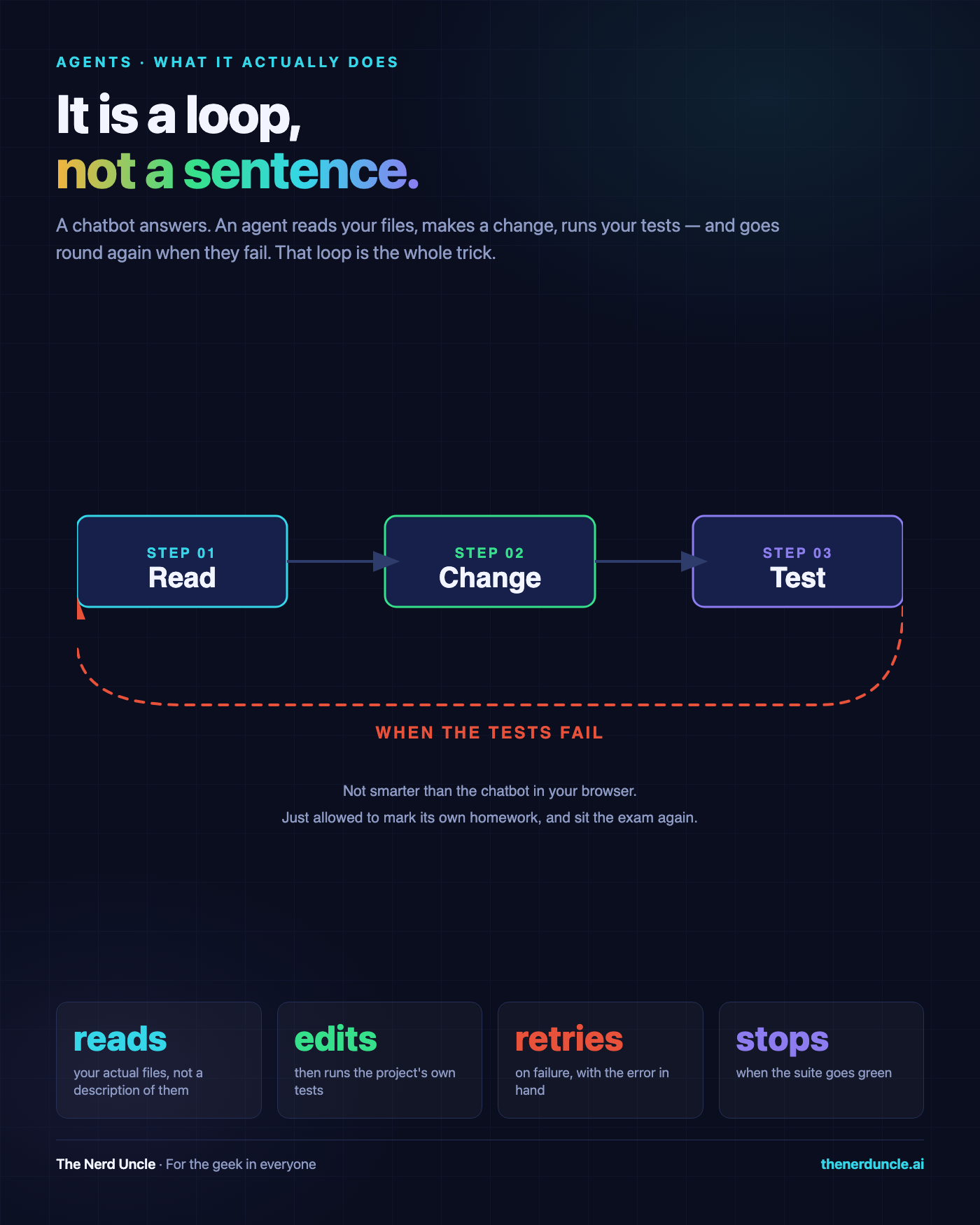
The difference that matters
A chatbot answers and stops. You ask, it replies, the exchange is over. An agent is given a goal and keeps going: it breaks the job into steps, does them, checks what came back, and carries on. Meta's framing is that Muse runs long tasks on your behalf rather than answering a question in a single turn.
That is a real distinction, not marketing. It changes what can go wrong. A chatbot that misunderstands you wastes thirty seconds. An agent that misunderstands you spends an hour confidently doing the wrong thing, and you find out at the end.
What Meta has actually shipped
Muse Spark arrived in April as the first of the family, aimed at multimodal reasoning and coding. Spark 1.1 followed in July, and a smaller open-weight model, Glimmer, in August. In October came Muse Wonder, pitched at agent work, alongside an open-weight release Meta describes as the most capable yet produced in the United States — reported at 816 billion total parameters with 42 billion active, and a context window of a million tokens.
Those numbers are worth holding lightly. Parameter counts and context windows are the specifications manufacturers choose to publish, and they correlate loosely with whether a thing is useful to you. A million-token window means it can read a great deal at once. It does not mean it understands any of it.
What it costs, as best anyone can tell
Reporting describes three tiers: a free one, Power at around $20 a month, and Maximum at around $100. Weekly token allowances have been quoted for each, sourced to Meta's help pages and to remarks attributed to Zuckerberg rather than to a published price list. At least one outlet disputes that a free tier exists at launch.
We are flagging that rather than tidying it away. The honest position in October 2026 is that the shape of the pricing is clear and the details are not yet nailed down in public. If you are deciding whether to pay, check Meta's own page rather than ours.
The part nobody has solved
An agent that acts for hours needs standing permission to act. That is a different relationship from a chatbot, and it is where the hard questions live: what it is allowed to touch, what it does when it is unsure, and who is answerable when a long chain of small reasonable steps ends somewhere unreasonable.
Meta is not alone here and has not claimed to have solved it. Nobody has. The industry has shipped the capability well ahead of the conventions for supervising it, and the first serious failures will teach everyone more than the launch posts did.
What to do with that
If you want something that drafts, summarises or answers, a chatbot is still the right tool and probably cheaper. If you want something that will go away and do a multi-step job — research a question properly, work through a codebase, handle a queue — that is what an agent is for, and Muse is Meta's entry.
Give it work you can check. The loop only helps if someone is closing it.