
The man who built Claude.
Dario Amodei trained as a physicist, moved into biology, and ended up running the lab behind one of the most used AI models in the world. The through-line is a single uncomfortable idea.

Physics, then brains, then machines
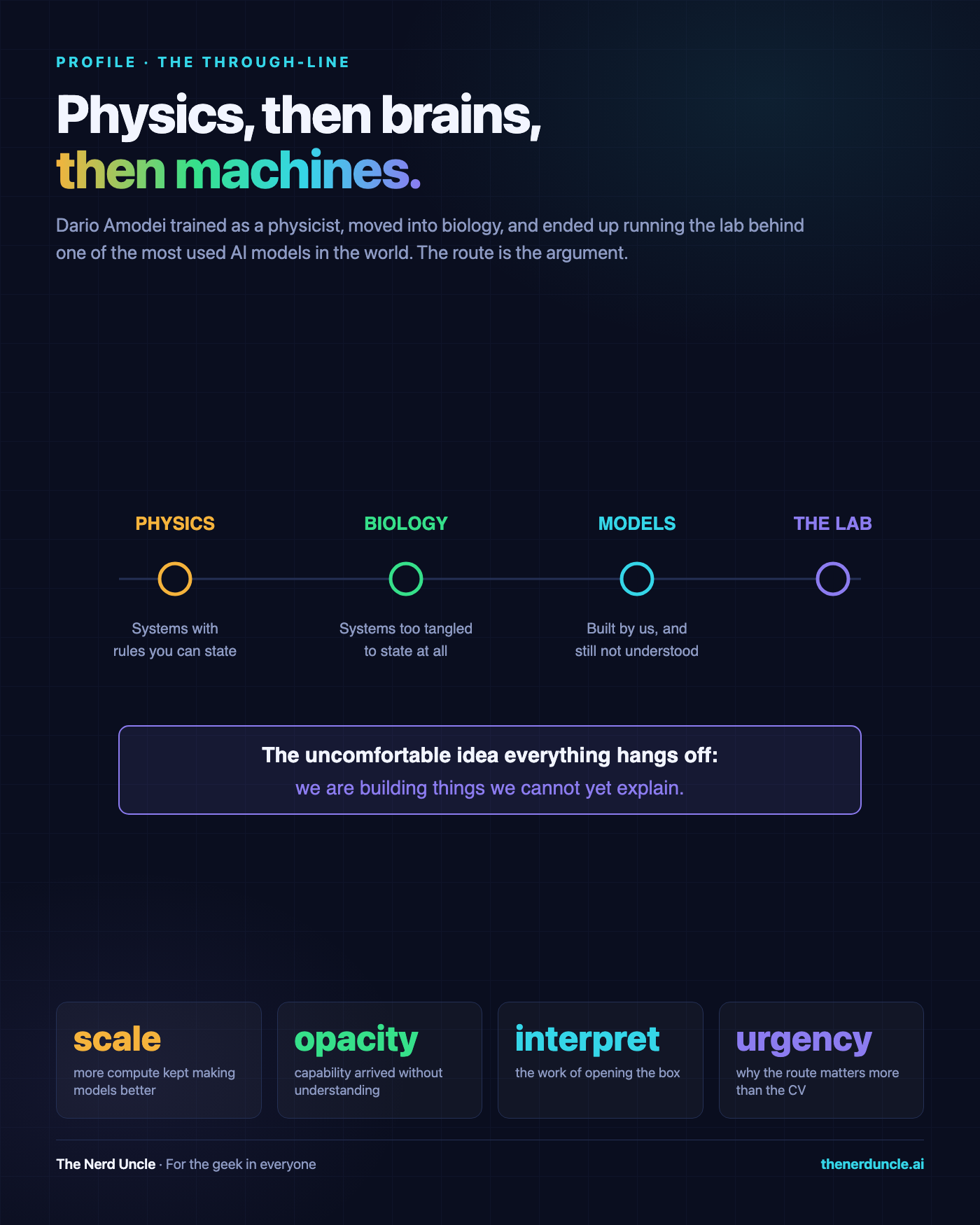
Amodei took a physics degree at Stanford and a doctorate in biophysics at Princeton, and came into AI through computational neuroscience rather than software. That order matters: he arrived treating neural networks as systems to be measured rather than products to be shipped.
He joined OpenAI in 2016 and rose to vice president of research, working on the GPT-2 and GPT-3 generations. He is also a co-author of the 2017 paper that introduced learning from human preferences — the technique now universally called RLHF, and the reason modern assistants are polite rather than merely fluent.
The idea everything else hangs off

His best known contribution is documenting scaling laws: the finding that these systems get predictably better across a wide range of tasks as you add compute and data. Not mysteriously better. Predictably — closely enough that you can forecast roughly what the next model will be able to do before you have built it.
Read it one way and it is an investment thesis, which is how most of the industry read it. Read it the other way and it is a warning: if capability is forecastable, so is the arrival of capabilities nobody has worked out how to govern. He has consistently read it the second way.
Leaving, and why
In 2021 he left OpenAI with a group of colleagues — including his sister Daniela, who is Anthropic’s president — over differences about commercialisation and safety. They founded Anthropic that year. Claude is its model.
The technical signature of the place is Constitutional AI: instead of relying only on human raters to mark answers good or bad, the model is given an explicit written set of principles and trained to critique and revise itself against them. The interesting part is not that it works, it is that the rules are written down and can be read — which makes them arguable.
Why it is worth your attention
You do not have to find any of this inspiring to find it useful. The position is unusual in the industry: a company arguing its own product is dangerous enough to need published limits, while building it as fast as it can. That tension is either hypocrisy or the only honest posture available, depending on the day.
What it means practically, if you are buying rather than building, is that there is a vocabulary now for what a system will refuse to do — and a precedent for expecting a vendor to put that in writing. That is worth more to an operations team than any benchmark.